Tata Nano, other Indian small cars fail independent crash tests


Some of India's best-selling small cars have failed independent crash tests conducted by a global car safety watchdog.

All five small cars popular on the Indian market last year, including the famous Tata Nano and the Hyundai i10, failed the crash tests performed by London car-safety watchdog Global NCAP (New Car Assessment Programme).
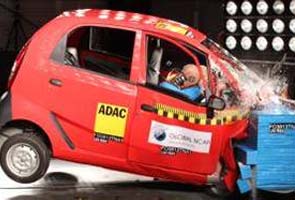

Tata Nano crash tested to check car safety regulations

The cars that were tested were the Tata Nano, Maruti Suzuki Alto 800, Hyundai i10, Ford Figo and Volkswagen Polo. All cars had to be made-in-India models only, and the most basic or entry-level version available in the market was selected for testing. This meant none of them had airbags - one of the most basic prerequisites globally to pass a safety test.

There were two tests carried out on identical cars of the same make - meaning two of each car were procured by Global NCAP from Indian showrooms, and shipped to Germany for the tests. One crash test was performed at 56 kmph, the other at 64 kmph.

All five cars failed the test, landing a zero on a scale of 1-5.

Representatives from each manufacturer were invited to witness the test, and the results have been shared with them all too. Automakers said the issue of car safety is complex, involving not just passenger safety, but also the safety of those outside the car. That means cars need to handle well and drivers must be educated about the rules of the road, and roads should be in good condition.
As NDTV's Automobiles Editor, I was consulted on which cars should be tested. Of the five cars, only the Figo and Polo showed good structural rigidity and therefore a safer cabin, while the smaller cars performed rather poorly. What is rather surprising to me is that a car like the Hyundai i10 - which is only made in India for global markets - also did badly. The made-in-India for export to Europe i10 has a good rating in its Euro NCAP test for instance, which begs the question - are the cars for Indian buyers made differently?

India's growing middle class has helped fuel a booming auto industry, making the country the world's sixth-largest car market. But nearly 140,000 people die on Indian roads every year in nearly five lakh accidents. That's the worst road safety record in the world.

Given those grizzly statistics, it is staggering to think India is the only country in the world's top ten car markets that does not have a comprehensive testing programme that measures the safety of cars.

Reactions from carmakers:

TATA MOTORS

"Tata Motors sees safety as a priority, and is going to closely review the results of the Global NCAP test, before drawing any conclusions vis-a-vis its product strategy. However all its cars do meet all Indian safety regulations as mandated by the government, at this time."

FORD INDIA

"Safety is one of the higher priorities in the design of our vehicles. Our vehicles consistently meet or exceed applicable industry standards. We are monitoring the progress of this review."

VW INDIA

"At Volkswagen, we recognise this need, given increasing driving speeds, more women drivers, longer driving times and a younger driver. Therefore, we have decided to have front dual airbags as standard on the Polo, as our continuing commitment to safer and better driving. We are the first automaker in India to do so, making the Polo the safest premium hatchback in the market today."

HYUNDAI MOTOR INDIA

"Hyundai Motor India Ltd affirms that Hyundai vehicles are designed and build to meet all the prescribed safety standards set by Indian Regulatory Authorities."

I V RAO, HEAD OF R&D, MARUTI SUZUKI INDIA

"In India we had been basing our own safety regulations from European regulations, however based on Indian market situation and Indian road conditions and usage conditions we have been fine tuning the regulations. The global NCAP may not match our own requirements in India, so I SIAM is in discussions with the ministry of road transport and heavy industry to work on a new vehicle appraisal system which will work on this for all NCAP for India. Taking into consideration how vehicles are being used in India not only in terms of features but small issues like the usage of rear seats is also equally important in India unlike other countries. So all these factors have to be considered and also the accident analysis has to really access what is actually causing the accident.

"The NCAP will basically come into to force when accident happens and majority of accidents are not because of your own four wheelers' but other vehicles on the road so it's a very complicated issue and of course what we are learning from this conference is very good. I would compliment IRTE for organizing such a conference here and auto industry is going to comply with the various safety measures mandated by the government. Unfortunately the commissioning of test facilities for offside and side impact has been delayed so in a couple of years we will introduce the off side regulation in India"


Source: NDTV Profit

CNG price cut may be temporary: Goldman

The cost of CNG, which will get reduced by up to Rs. 15 per kg in the next few days following a rejig in natural gas allocation, will go up by Rs. 10.6 a kg in April, when domestic gas prices almost double, Goldman Sachs said.

The oil ministry yesterday said city gas distribution (CGD) companies would get cheaper domestic gas to meet all of their requirements for CNG and piped natural gas (PNG) supplies to households compared with the previous limit of 80 per cent for most states.

As a result, Indraprastha Gas Ltd will cut CNG/PNG prices by aboutRs. 15 per kg and Rs. 5 per cubic metre, respectively.

"We note that this is only a temporary relief to consumers as the domestic natural gas prices will almost be doubled from the current $4.2 from April 1, thus forcing the CGD companies to raise CNG/PNG prices to pass on the increased costs.

"In the absence of any offsetting subsidy, they would need to raise CNG prices by Rs. 10.6 per kg and PNG prices by Rs. 8 per standard cubic meter," Goldman Sachs said in a research note.

It said the price of CNG in Delhi will fall to Rs. 35.1 a kg from the current level and then rise to Rs. 45.7 a kg in April.

Goldman Sachs estimates the price of locally produced natural gas will climb to $7.8 per million British thermal units in April from $4.2 currently after the Rangarajan formula for pricing domestic gas is implemented.

The formula calls for pricing all domestically produced natural gas at the average of international hub rates and the cost of imported liquefied natural gas (LNG) in India.

Oil Minister M Veerappa Moily yesterday said the price cut was possible because the government had decided to meet the entire need of CNG and PNG from domestic gas, which is subject to an administered pricing mechanism (APM). This eliminates the need to import costlier LNG.

Retail prices are set to fall in all states, except Maharashtra and Haryana, as city gas distributors stop buying higher-priced LNG and shift entirely to APM gas.

City gas entities in Mumbai and Pune as well as Faridabad in Haryana get all of their requirements from APM gas. Goldman said the additional requirement of 1.92 million standard cubic meters a day of domestically produced gas will be met by cutting supplies to non-priority sectors.


Source: NDTV Profit

Currency notes issued before 2005 to be withdrawn: RBI

The Reserve Bank today decided to withdraw all currency notes issued prior to 2005, including Rs. 500 and Rs. 1,000 denominations, after March 31 in a move apparently aimed at curbing black money and fake currencies.

"After March 31, 2014, it (RBI) will completely withdraw from circulation all bank notes issued prior to 2005. From April 1, 2014, the public will be required to approach banks for exchanging these notes," the RBI said in a statement.

The public can easily distinguish the currency notes issued before 2005 as they do not have the year of printing on reverse side. The year of printing in a small font is visible at the middle of the bottom row in notes issued after 2005.

Asking people not to panic and cooperate in the withdrawal process, the Reserve Bank of India (RBI) said old notes will continue to be legal and can be exchanged in any bank after April 1.

"From April 1, 2014, the public will be required to approach banks for exchanging these notes. Banks will provide exchange facility for these notes until further communication," the RBI said.

From July 1, 2014, persons seeking exchange of more than 10 pieces of Rs. 500 and Rs. 1,000 notes will have to furnish proof of identity and residence to the bank.

Although the RBI did not give any reason for withdrawal of pre-2005 currency notes, the move is expected to unearth black money held in cash.

As the new currency notes have added security features, they would help in curbing the menace of fake currency.

At present, currency notes in denominations of Rs. 5, Rs. 10, Rs. 20, Rs. 50,Rs. 100, Rs. 500 and Rs. 1,000 are issued.


Source: http://profit.ndtv.com/

IMF Ups India’s Current Growth Estimate to 4.4%

The International Monetary Fund (IMF) has bumped up India’s growth forecast for the current fiscal by more than half a percentage point thanks to a normal monsoon and improved exports, virtually admitting that it may have been too pessimistic in October when it pegged the number at less than 4%. 
Finance minister P Chidambaram had led India’s strong protests against IMF’s
assessment, which was made amid economic gloom and a depreciating currency. In an update of its flagship World Economic Outlook (SEO), the IMF said on Tuesday that India will grow 4.4% in 2013-14 in terms of market prices against the 3.8% estimated initially, citing a better second half. “Growth in India picked up after a favourable monsoon season and higher export growth and is expected to firm further on stronger structural policies supporting investment,” it said. 
In terms of factor cost, which is the more widely used method of computing national income in India, growth is pegged at 4.6%, revised upward from 4.25% estimated earlier. 
IMF sees growth rising to 5.4% in 2014-15 and 6.4% in the year after, which is lower than the respective 6.2% and 7.1% recovery forecast by its Bretton Woods twin, the World Bank. 

The estimate for 2014-15 is marginally higher than the October forecast of 5%. The fund said global activity strengthened in the second half of 2013 and expects it to gather pace thanks to a recovery in advanced economies. It sees 2014 calendar growth at 3.7% against 3.6% estimated earlier, which is forecast to rise to 3.9% in 2015. “The basic reason behind the stronger recovery is that the brakes to the recovery are progressively being loosened. The drag from fiscal consolidation is diminishing. The financial system is slowly healing. Uncertainty is decreasing,” said Olivier Blanchard, IMF chief economist. 
The report – Is the tide rising? – warns that “downward revisions to growth forecasts in some economies highlight continued fragilities, and downside risks remain”. Estimates have been lowered for the Association of Southeast 
Asian Nations (Asean), Italy and the Commonwealth of Independent States, or CIS, led by Russia. 
It said the euro area was turning the corner from recession to recovery, adding that growth is likely to rise to 2.8% in the US in 2014 from 1.9% in the current year, which is good news for India’s exports. The report cautions against any rushed withdrawal of stimulus programmes. 
“With prospects improving, however, it will be critical to avoid a premature withdrawal of monetary policy accommodation, including in the United States, as output gaps are still large while inflation is low and fiscal consolidation continues,” it said, adding that strong growth is needed to repair balance sheets. 
In the case of emerging market and developing economies, it said there was a need to manage the risk of potential capital flow reversals.


Source: The Economics Times

DECEMBER FLIGHT STORY IndiGo Slips for a 2nd Month, but is Still Numero Uno

India’s largest passenger carrier IndiGo lost market share for the second consecutive month as its market share slipped marginally to 28.2% in December 2013 as compared to 28.6% in the previous month. And clambering back to the second spot in December was low-cost carrier SpiceJet with a 19.1% market share, which it shared with Jet Airways, which reported a market share of 19.1% in December. However, when combined with JetLite, the Jet Airways Group was the second-largest airline with 24.6% market share, courtesy Jet-Lite’s 5.5% share. GoAir, which was the largest gainer in November 2013, kept its market share at 8.8% during December, while Air India’s share fell marginally to 19%. 
Market leader in India, and also the most profitable airline, IndiGo’s declining share for the second successive issue was not a serious issue. “It’s just a marginal drop in market share and such fluctuations keep happening. They have kept it more or less at November levels. But November was a big drop and that was due to an aircraft which was grounded for maintenance. It meant IndiGo had lower capacity, while GoAir added its capacity in November by taking delivery of another aircraft,” an aviation industry consultant, who did not want to be quoted, said. The month of December also brought some cheer to the airlines. More passengers flew in December 2013, than they did in the same month of the previous year. 
Overall, domestic airlines carried 55.86 lakh passengers or 3.37% more, during December 2013 as compared to the same month last year. During the full calendar year 2013, airlines carried 6.14 crore passengers or 4.43% more than the previous calendar year. Apart from Air India’s slight drop in 
market share, the greater concern was its on-time performance during December 2013. After achieving 82% on-time performance from top six metros in the first half of the 2013-14 fiscal, the airline’s on-time performance at top six metros during December was the lowest at 69.8%. The airline is preparing to join Star Alliance over the summer. 
In terms of on-time performance, SpiceJet, which is chasing the more lucrative corporate clientele, achieved the best performance in December 2013, with 82.2% of its flights operating on schedule from the top six metros. With a total score of 82.2% of flights on-time, SpiceJet was at the top of the list on the parameter of on-time performance (OTP) for 
December 2013. 
On-time performance of scheduled domestic airlines is computed by the DGCA for six metro airports — Bangalore, Chennai, Delhi, Hyderabad, Kolkata and Mumbai. There was also good news for airlines in terms of load factors. All airlines improved over November 2013, but the leader of the 
pack in December was JetLite, which was flying its planes 78.5% full. 
Air India’s flights were also operating more than three quarters full with 77.3% load factors during the month. IndiGo’s flights were marginally less full than Air India’s as the low-cost carrier had 77.1% load factor. 
Regional carrier Air Costa, which is based out of Hyderabad, was the surprise of the month. The carrier, which struggled to fill its planes even by half during the first two months of operations, had load factors of 72.6% during December 2013. 
During the calendar year, Air India also managed to eat into a portion of the private carrier’s market with a 10.46% growth over the number of passengers carried last year. Air India carried 119.09 lakh domestic passengers in 2013.


Source: The Economics Times

Mobile Launches Grow 85% in 2013: The Economics Times


CHASING MARKET LEADER P&G To Invest 1,500 cr in India to Catch Up with HUL

 P&G Home Products, an Indian unit of Procter & Gamble, will borrow . 1,500 crore in the form of inter-company loan, the firm has said amid efforts to catch up with market leader Hindustan Unilever. 
The unlisted maker of Tide detergent and Pantene shampoo has passed a special resolution for the borrowing, which will be in addition to its paid-up capital and reserves, according to its annual filing with the Registrar of Companies last week. The company did not specify the time frame for the borrowing or how it would be used. 
A spokesperson for P&G did not respond to ET’s specific query on how the funds would be utilised, but said, “Inter-company borrowing is regular business practice where funds move between different divisions at different times. Since our Indian operations are spread across three different legal entities, it is routine to make updates on such plans to move funds within our own legal entities as per the Companies Act.” 
Analysts say the company would have to direct most of the funds to capacity expansion if it has to include more brands from the group’s global portfolio. “Setting up more manufacturing units and expanding exist
ing plants will be key for P&G if they want to launch more brands from its parent company,” said Nitin Mathur, consumer research analyst at Espírito Santo Securities. 
P&G Home Products has already invested more than . 2,000 crore over the last two years to spruce up its existing factories and set up a new multi-product plant near Hyderabad. The company’s efforts at increasing local production are aimed at cutting 
dependence on costly imports. For instance, the company, which entered the toothpastes category six months ago, is dependent on China for most of its oral-care supplies. 
P&G is the world’s largest consumer goods company by revenue. Despite clocking a CAGR of 25% in India in the last decade, it has been facing criticism for its increased spending in emerging markets at the cost of expansion in developed coun
tries, which had been a cash cow for the global company. The huge investment in India, in turn, has impacted its local profitability. 
P&G Home Products posted a loss of . 481.5 crore in 2012-13 — its third consecutive loss and the highest so far — as it engaged in a price war despite rising commodity costs. In contrast, the net profit of Unilever’s local arm grew more than 40%. 
With a two-decade-long presence in India, P&G rakes in over a billion dollars in revenues through its subsidiaries — Procter & Gamble Health & Hygiene, Gillette India and Procter & Gamble Home Products. The group, however, has been slow in increasing its local market share in comparison with HUL. 
“While Tide and Olay gained share rapidly in the initial years after their launch, both brands seems to have plateaued now. Even its latest brand Oral B hasn’t made much impact with Colgate still gaining share every quarter,” a senior analyst at a domestic brokerage house said, requesting anonymity. There are production issues, too. Last year, Delhi-based third-party manufacturer JHS Svendgaard took P&G to the competition watchdog when it did not renew an agreement to make its laundry brand Tide. 
sagar.malviya@timesgroup.com 


Source: The Economics Times
By:  SAGAR MALVIYA